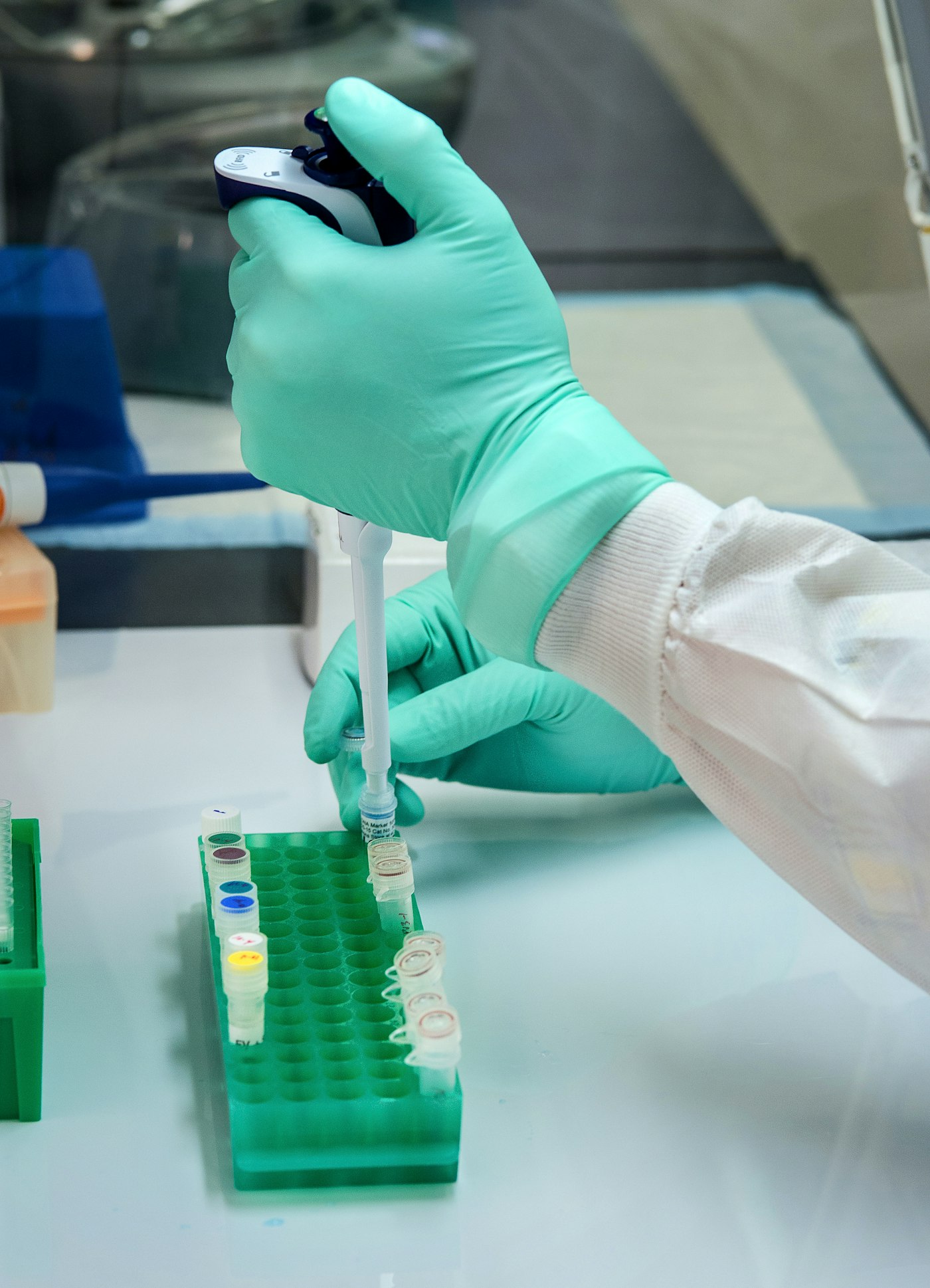
What peptides are
A peptide is a short chain of amino acids, the same building blocks that form proteins, only far smaller. The body already makes thousands of them, and many act as signalling molecules: rather than forcing an outcome, they instruct cells to repair tissue, calm inflammation, form blood vessels or defend a surface such as the gut lining. That signalling role is why interest in peptides as gentle, targeted support has grown so quickly in both human and veterinary research.
How peptides are studied
Peptide research runs along a familiar path: from cell studies (in vitro), to animal models (preclinical), to controlled trials in the target species. The recovery peptides we focus on, BPC-157 and TB-500, sit at the preclinical end: encouraging cell and rodent data, a long track record of anecdotal use in performance-animal circles, but limited controlled companion-animal trials.
"Promising in a rodent study" and "proven in dogs" are very different claims. A trustworthy brand tells you which one it is holding, for every product, on every page. Ours are at the promising end, and we say so.
How we grade the evidence, one honest band
We will not overstate the science to make a sale. Every peptide we sell sits at the emerging edge of the evidence: biologically plausible, widely used, promising in preclinical and performance-animal settings, but not yet proven in large, controlled companion-animal trials.
That is the honest picture, and we would rather lead with it than bury it. What we can stand behind completely is not efficacy hype but verifiable quality: every batch independently tested for purity and identity, with a Certificate of Analysis in every order. We prove what is in the vial, and we are straight about what the science does and does not yet show.
Research summaries
BPC-157, recovery & the gut
BPC-157 ("Body Protection Compound") is studied for soft-tissue, tendon and connective-tissue repair, blood-vessel formation and anti-inflammatory signalling. It was originally isolated from gastric juice and first investigated in the gut. The evidence is largely rodent and cell-model to date, with strong anecdotal use in working- and sport-animal circles.
TB-500 (Thymosin β4), tissue repair
TB-500 is a synthetic fragment of a naturally occurring peptide involved in cell migration and repair, discussed for deeper, longer-arc tissue recovery. Like BPC-157, its evidence is largely preclinical, with the longest real-world track record in equine sports medicine.
The Blend, both, in one vial
Our BPC-157/TB-500 Blend combines the two at 50/50 mg. The rationale is complementary rhythms, BPC-157's daily soft-tissue support with TB-500's deeper repair, in a single, convenient injection.
The limits of the evidence, and why we say so
Companion-animal peptide data is genuinely limited, and individual results vary. We would rather lose a sale than overstate the science. Every product is research-use nutritional support, not a registered veterinary medicine, and nothing here is intended to diagnose, treat or cure disease. Always involve your veterinarian, especially for young, pregnant, elderly, unwell or medicated animals.